


AI has already changed the way we work, create, shop, and communicate—but the real transformation is just beginning. As we move through 2025, artificial intelligence is poised to take even bolder steps forward, not just in capability but in how it integrates with our lives, businesses, and even laws.
Here are the key AI trends to keep an eye on in 2025 and beyond.
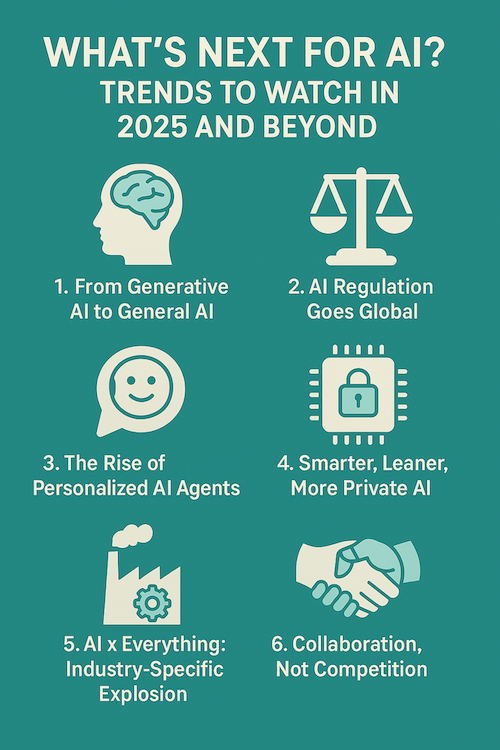
1. From Generative AI to General AI
Generative AI (like ChatGPT or image generators) has dominated headlines, but the next frontier is Artificial General Intelligence (AGI)—AI that can understand and learn any task a human can.
We’re not there yet, but research is accelerating. Expect more models that can reason better, connect across domains (e.g., text + images + audio), and adapt to unfamiliar tasks without retraining.
What to watch: Multimodal models, autonomous agents, and early AGI frameworks.
2. AI Regulation Goes Global
With power comes responsibility—and governments are catching up. The EU’s AI Act, U.S. executive orders, and global AI summits have made one thing clear: regulation is coming.
Expect stricter rules around:
- Transparency (how AI makes decisions)
- Data privacy
- Deepfakes and misinformation
- High-risk AI applications (e.g., in healthcare, hiring, and policing)
Businesses will need to ensure their AI tools are compliant, ethical, and explainable.
3. The Rise of Personalized AI Agents
In 2025, AI is getting more personal. Instead of just asking ChatGPT questions, you’ll have AI agents that learn your preferences, handle recurring tasks, and even make decisions for you.
Imagine:
- A digital assistant that manages your calendar, messages, and shopping
- An AI tutor customized to your learning style
- A personal finance agent that auto-optimizes your spending
These agents will act more autonomously—blending AI, APIs, and decision-making logic.
4. Smarter, Leaner, More Private AI
The next wave of AI models won’t just be big—they’ll be efficient and privacy-focused.
We’re seeing the rise of:
- Edge AI: Models that run locally on phones, cars, or smart devices
- Open-source models: Customizable, transparent, and community-driven
- Federated learning: Training AI without sending your data to the cloud
This makes AI faster, cheaper, and more private—perfect for sensitive industries like healthcare and finance.
5. AI x Everything: Industry-Specific Explosion
AI will go deeper into every field—not just as a general tool, but one tailored to specific industries:
- Healthcare: AI-powered diagnostics, drug discovery, and virtual health assistants
- Finance: Real-time fraud detection, robo-advisors, and market prediction
- Education: AI tutors, personalized learning paths, and grading automation
- Manufacturing: Predictive maintenance, smart robotics, and supply chain optimization
Look out for a boom in “vertical AI” startups offering plug-and-play solutions for niche markets.
6. Collaboration, Not Competition
One of the most exciting shifts? People are learning to work with AI, not fear it.
In creative fields, AI is becoming a co-pilot—helping writers, artists, designers, and coders go further, faster. In business, it’s automating the boring stuff so humans can focus on strategy and innovation.
The future isn’t “AI vs. humans.” It’s humans with AI—amplifying what we do best.
The Future Is (Already) Here
AI isn’t just advancing—it’s evolving into something far more integrated, personal, and powerful. While there are valid concerns around ethics, privacy, and disruption, the opportunities are massive.
The key? Staying informed, adaptable, and intentional about how we build and use this technology.
2025 will be a defining year. The question is: Are you ready to shape the future—or be shaped by it?